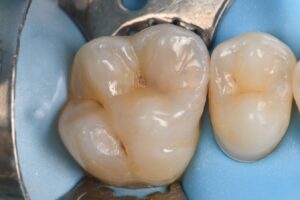
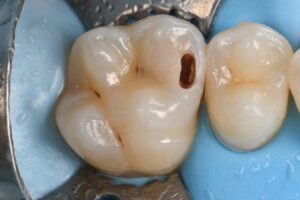
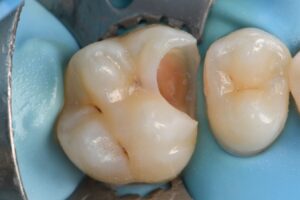
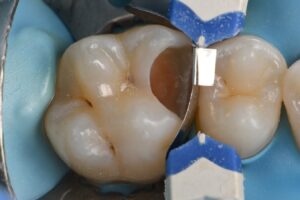
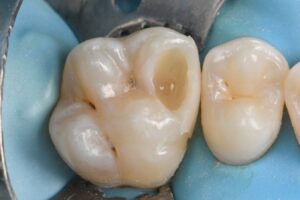
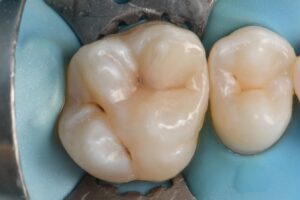
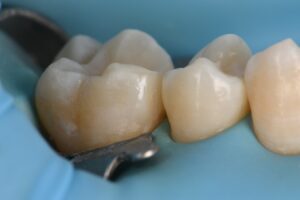
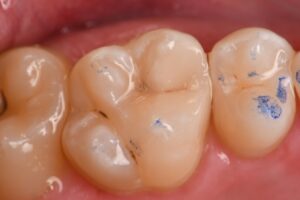
Proximal emergence profile and occlusal embrasure formation are two key aspects of re-creating anatomy in a Class II restoration.
Concepts:
// Separation force: provided by the tension ring which is able to be placed on your terminal/clamped tooth in the case of Garrison’s Compositight 3D Fusion
// Band: Deadsoft bands provide a Teflon-coating and have better visual contrast, but Firmbands have better contour control and less deformation is likely with tight proximal fits/close interdental spaces.
// Occlusal embrasure formation: formed with the band, but can be accentuated using both needle-point diamonds on an angle and also Sof-Lex discs in a sweeping motion towards the center of the restored tooth.
// Bevel: the closer you are to a cusp tip the more aggressively one must bevel to maximize the number of enamel rods engaged when bonding. It is always better to bond to the ends of enamel rods relative to the sides of them.
// Restorative material: microlayering and respecting the DWT concept where dentin microlayers are left to hybridize for 5 minutes without involving a significant volume of enamel is key to maximizing shear bond strengths. C-factor influences minimizes aggressive polymerization shrinkage stresses (both volumetric and interfacial)
#VocoGrandioSO #GarrisonCompositight3DFusion #classIItipsandtricks